Compact binoculars
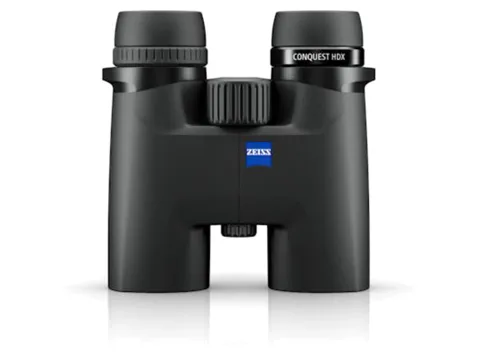
Zeiss Conquest HDX 8x32
A compact Zeiss 8x32 that is bright at first light and small enough to live on your chest all season.

Photo: National Park Service (Yellowstone National Park (NPS/Neal Herbert)) (Public domain)
Field Guide
Black Friday optics price drops, free by email.

Most binoculars are designed around an average adult man. If your eyes sit closer together, your hands are smaller or you simply want a lighter carry, a full-size binocular can leave you with a dark edge in the view, a focus wheel you stretch to reach and a sore neck by noon. The fix is fit, not lesser glass.
The distance between your pupils is called interpupillary distance, or IPD. Your optometrist may list it as PD on a glasses prescription. Adults range from about 51 to 74mm, and women average a few millimeters narrower than men.
Every binocular has a minimum IPD, the closest its two barrels can fold together, and you will find it on the spec sheet. If that number is wider than your eyes, you will see two circles or a black edge no matter how you hold it. Compact 32mm binoculars usually fold narrower than 42mm models, which is one reason they fit many women better.
To measure your own IPD, stand in front of a mirror with a millimeter ruler across your brow, close one eye and line up zero with the center of the open pupil, then switch eyes and read the center of the other pupil.
A full-size binocular hangs on your chest from first light to dark. Dropping from a 42mm to a 32mm objective saves real weight: the Vortex Razor UHD runs 32.2 oz in 8x42 and 21.9 oz in 10x32. A harness that spreads the load across your shoulders helps more than any strap, and a light tripod takes the weight off your arms for long sits.
Hold the binocular before you buy if you can. Your fingers should reach the focus wheel without shifting your grip, and the barrels should fill your hands without your thumbs straining. Open-bridge designs leave more room for small hands. A shorter 32mm body is easier to hold steady, and an 8x view shakes less than a 10x.
If you hunt in glasses, look for long eye relief and twist-up eyecups with several stops, so you see the full field of view with your glasses on. Try the eyecups fully down with your glasses, then fully up without them.
A small rangefinder fits a pocket or a chest pouch and is easy to hold steady with one hand. Rangefinding binoculars combine two tools into one, which saves weight on the chest. For a rifle, get the stock length of pull right first, then mount the scope so you see a full picture without crowding forward.
We may earn from retailer links. Price on Nov 19, 2026.
Compact binoculars
A compact Zeiss 8x32 that is bright at first light and small enough to live on your chest all season.
Compact binoculars
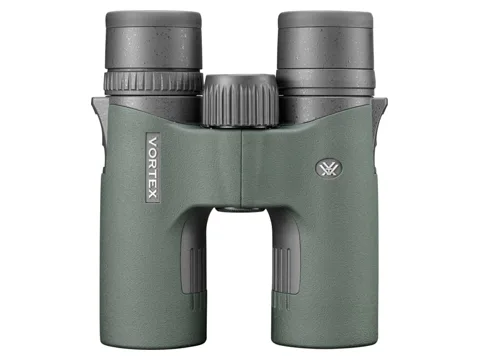
Vortex top-tier glass in a 10x32 body. 21.9 oz, against 32.2 oz for the same line in 8x42.
Compact binoculars, best available
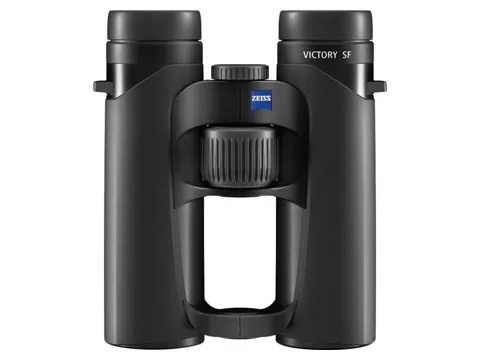
Zeiss Victory glass in a light 8x32 body. Bright, wide and easy to carry all day.
Rangefinding binoculars, best available
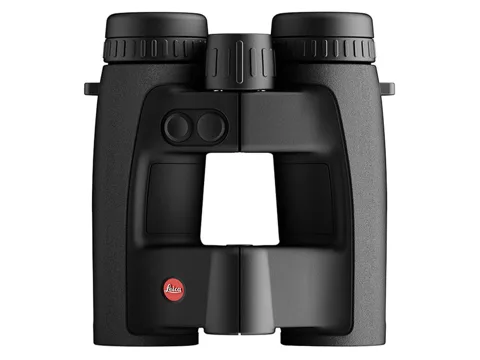
Leica binoculars and a rangefinder in one compact 8x32 body, so there is one less thing on your chest.
Small rangefinder
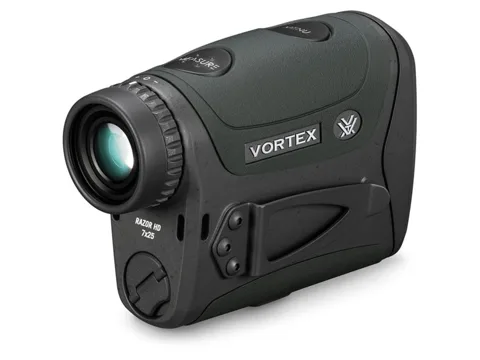
Reads out to 4,000 yards on reflective targets, with angle compensation and clear 7x glass. 9.9 oz.
Small rangefinder
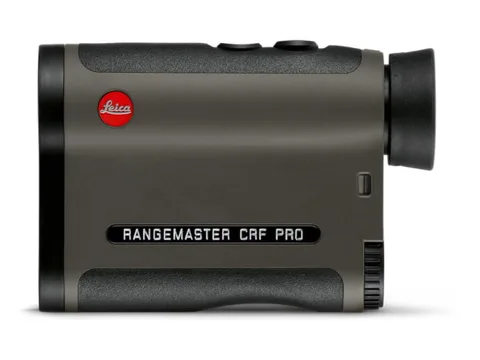
A small Leica rangefinder with excellent 7x24 glass and fast, steady readings.
See each kit for the rest of the glass: elk, mule deer, pronghorn, sheep and goat, moose, bear, whitetail. Or start at draw season glass kits.